English
You've landed on a search for P2.6 LED video wall manufacturers and now you're staring at a screen full of supplier names, price ranges that seem all over the place, and spec sheets that look identical until you actually read them closely. Here's the straight answer I wish someone had given me years ago: factory-direct P2.6 LED video wall panels from reputable Chinese manufacturers typically run between $100 and $280 per 500×500mm cabinet depending on component tier, production lead times sit at 18-25 days, and the manufacturers worth your time are concentrated in Shenzhen's Bao'an and Longgang districts where the entire LED supply chain lives under one roof.
I've spent years helping event companies, AV integrators, church installation teams, and corporate buyers across North America, Europe, Australia, and the Middle East source P2.6 LED panels directly from Chinese factories. I've seen the good — manufacturers who ship perfectly calibrated panels with spare parts packages and responsive engineering support. And I've seen the ugly — buyers who received panels with mismatched LED batches, no aging tests, and cabinets that warped after a few setup cycles. The gap between those two outcomes almost always comes down to how thoroughly you vet the manufacturer before placing your order.
P2.6 means the pixel pitch — the distance from the center of one LED pixel to the center of the next — is 2.6 millimeters. At this density, you're looking at roughly 147,456 pixels per square meter. That's dense enough for viewers standing 2.5 to 3 meters away to see a smooth, continuous image without noticing individual pixel dots.
The reason P2.6 has become one of the most popular pixel pitches for indoor applications comes down to a practical balance:
Viewing distance — P2.6 delivers crisp imagery at distances of 2.6 meters and beyond, which covers the majority of indoor environments: conference rooms, retail spaces, house of worship sanctuaries, trade show booths, and corporate lobbies
Price-to-performance ratio — It sits right in the middle of the cost curve. P1.5 or P1.9 panels deliver sharper images but cost 40-80% more. P3.91 panels are cheaper but look noticeably pixelated at closer viewing distances. P2.6 hits the sweet spot where most buyers get the resolution they need without overpaying for pixel density they won't use
Availability — P2.6 is one of the highest-volume production runs for Chinese manufacturers, which means shorter lead times, competitive pricing, and a deep pool of spare parts
If your viewers will mostly be 3 meters or further from the screen, P2.6 gives you excellent image quality without the premium price tag of finer pitches. If your audience is closer than 2 meters — think interactive kiosks or museum displays — you'd want to step down to P1.5 or P1.2.
This is the fork in the road that shapes everything else in your purchasing decision. P2.6 panels come in two fundamentally different form factors, and mixing them up is one of the most common mistakes I see buyers make.
| Feature | P2.6 Fixed Installation Panels | P2.6 Rental Panels |
|---|---|---|
| Cabinet Material | Sheet steel or die-cast aluminum | Die-cast aluminum (mandatory) |
| Cabinet Weight (500×500mm) | 8-12 kg | 6.5-8 kg |
| Cabinet Thickness | 60-80mm | 45-88mm |
| Service Access | Front or rear maintenance | Front and rear service |
| Locking System | Screw-mounted or magnetic | Quick-lock with self-aligning pins |
| Typical Brightness | 800-1,200 nits | 1,000-1,500 nits |
| Price per Cabinet (500×500mm) | $90-$200 | $120-$280 |
| Assembly Frequency | Installed once, stays put | Assembled/disassembled per event |
The key difference is durability under repeated handling. Rental panels get assembled, disassembled, loaded into flight cases, transported, and reconfigured hundreds of times over their lifespan. That demands die-cast aluminum cabinets (lighter and more dimensionally stable than steel), precision quick-lock mechanisms that don't wear out, and reinforced connector ports that survive hundreds of plug cycles.
Fixed installation panels, on the other hand, go up once and stay there. They can use heavier sheet steel cabinets, simpler mounting hardware, and don't need the same level of physical robustness. That's why they cost less — you're not paying for the engineering that handles repeated teardown and rebuild cycles.
I personally suggest being honest about your use case here. If you're outfitting a church or a corporate lobby that will have the same configuration for years, go with fixed panels and save 20-30%. If you're running events, trade shows, or a rental business, the extra cost for rental-grade cabinets pays for itself within the first year through reduced maintenance and replacement costs.
This is the question that separates successful buyers from the ones who end up writing cautionary tales on industry forums. The LED display manufacturing ecosystem around Shenzhen has thousands of registered companies. A meaningful number of them don't manufacture anything — they source LED modules from one factory, cabinets from another, power supplies from a third, assemble everything in a small workshop, and list themselves as "manufacturers" on Alibaba, Made-in-China, and Global Sources.
Here's my vetting checklist — the same one I use when evaluating suppliers for my own clients:
Surface Mount Technology lines are where LED modules get built. A high-speed SMT line capable of handling P2.6 components costs $400,000 to $1 million. A legitimate P2.6 manufacturer will have multiple lines running and will show them to you on a live video call without hesitation. If a supplier says "our production facility is in another city" or "let me arrange a factory tour next month," be suspicious. Real factories are proud of their production lines and will show them right then and there.
Every P2.6 panel needs to run continuously for 48-72 hours before shipping. This catches early failures — dead pixels, color inconsistency, power supply issues — that would otherwise show up at your installation. A proper aging room has rows of panels running simultaneously under monitored conditions, with data logging for brightness, color temperature, and dead pixels. If a supplier doesn't have an aging facility, they're skipping the most critical quality control step.
P2.6 panels require per-module calibration to ensure color and brightness consistency across the entire wall. This involves specialized equipment that measures each module's chromaticity and luminance, then adjusts the driving parameters accordingly. Budget manufacturers skip this step entirely, which is why their panels look fine individually but show visible color patches when tiled together on your wall.
When you need to discuss pixel mapping for a curved configuration, or ask about refresh rate optimization for camera capture at a corporate event, you should be talking to an actual engineer — not a sales representative reading from a FAQ document. I always test this during the quoting phase by asking specific technical questions about driver IC selection or thermal management. If the responses are vague or take days to come back, that's a red flag for after-sales support too.
I had a client in the UK who learned this the hard way. They'd been buying P2.6 indoor rental panels from a supplier for about eighteen months. Communication was smooth, prices were competitive, everything seemed great. Then for a major corporate event in London, six panels out of sixty developed visible color inconsistency right in the middle of the display. The "manufacturer" turned out to be a trading company that had quietly switched to a cheaper module supplier six months earlier. The new supplier's modules had different LED chip batches with no calibration matching. The client's reputation took a hit, the event organizer was not happy, and the trading company offered replacement panels three weeks after the event. Too little, too late.
Not all P2.6 panels are built the same, even when they share the same pixel pitch. Here's a breakdown of what actually matters on a spec sheet:
| Specification | Budget Tier | Mid-Range | Premium Tier |
|---|---|---|---|
| LED Chip Brand | Generic/unbranded | Kinglight, Silan | Nationstar Gold, Epistar |
| Driver IC | Basic FM series | Macroblock MBI5124 | Macroblock MBI5252 / Chipone ICN2053 |
| Refresh Rate | 1920Hz | 3840Hz | 3840Hz+ high PWM |
| Contrast Ratio | 3000:1 | 5000:1 | 8000:1+ |
| Cabinet Material | Sheet steel | Die-cast aluminum standard | Die-cast aluminum, CNC-machined |
| Power Supply | Generic brand | G-Energy or equivalent | Mean Well |
| Cabinet Weight (500×500) | 10-12 kg | 7-8 kg | 6.5-7.5 kg |
| Price per Cabinet | $90-$150 | $150-$220 | $220-$300 |
The LED chip is the single most important component in a P2.6 panel. Nationstar — especially their Gold series — is the industry benchmark for reliability and color consistency. At P2.6, you're packing roughly 147,000 pixels per square meter, which means over 440,000 individual LED sub-pixels. Each one needs to perform consistently over thousands of hours. Nationstar Gold chips offer tight wavelength consistency (±1.5nm), high reliability under continuous operation, and minimal brightness degradation over time. Epistar is another strong option, particularly popular for applications in warmer climates.
Driver ICs matter more than most buyers realize. The driver IC controls how each LED pixel is addressed and driven. A high-quality driver IC like the Macroblock MBI5252 provides precise current control with ±1% accuracy, which translates to better grayscale performance, smoother color gradients, and no low-gray flicker. For applications involving cameras — corporate events with live streaming, broadcast environments, trade shows with social media coverage — this is critical. Panels with basic driver ICs at 1920Hz refresh rate will show visible flicker on camera, especially at lower brightness levels.
Power supply quality is another area where cutting corners has serious consequences. Mean Well power supplies are the industry standard because they handle voltage fluctuations, provide stable current to the LEDs, and have built-in protection against surges and overheating. Generic power supplies are the number one cause of premature panel failure — they overheat, their output voltage drifts, and eventually they burn out, taking LEDs and driver ICs with them.
Let me give you concrete numbers based on current market conditions for P2.6 LED cabinets sourced from Chinese manufacturers. These prices are for cabinets/panels only — video processors, mounting structures, cabling, spare parts, and shipping are all extra:
P2.6 Indoor Fixed Installation (500×500mm, die-cast aluminum):
Sample/small quantity (1-10 cabinets): $150-$250 per cabinet
Medium orders (20-50 cabinets): $120-$190 per cabinet
Large orders (100+ cabinets): $90-$160 per cabinet
P2.6 Indoor Rental (500×500mm, die-cast aluminum, quick-lock):
Sample/small quantity (1-10 cabinets): $180-$300 per cabinet
Medium orders (20-50 cabinets): $150-$240 per cabinet
Large orders (100+ cabinets): $120-$200 per cabinet
P2.6 Indoor Rental (500×1000mm, die-cast aluminum, quick-lock):
Sample/small quantity: $320-$520 per cabinet
Medium orders: $260-$420 per cabinet
Large orders: $210-$350 per cabinet
A few important notes about these prices:
Payment terms are typically 30% deposit via T/T, 70% balance before shipment. Never pay 100% upfront with a new supplier
If someone quotes you a P2.6 rental cabinet at $60, something is seriously wrong. They're using B-grade LED chips, skipping the aging test, or using the cheapest possible power supplies
For large-scale projects (200+ cabinets), manufacturers often offer significant volume discounts — sometimes 20-30% below the prices listed above
Flight cases typically add $15-$35 per cabinet depending on size and construction quality
This varies significantly by market, and getting it wrong can mean your panels get held at customs or rejected by a venue's safety inspector:
For the European Union:
CE marking is mandatory. This covers the Low Voltage Directive (LVD), Electromagnetic Compatibility (EMC) Directive, and RoHS for hazardous substances. The CE certificate should be issued by an accredited testing body — TÜV, SGS, or Intertek are the most recognized. Don't just accept a self-declared CE certificate from the manufacturer; verify it on the notified body's website.
For the United States:
ETL listing (from Intertek) or UL listing is what most electrical inspectors look for. FCC Part 15 compliance is also required for electromagnetic emissions. For P2.6 installations in venues like convention centers, corporate lobbies, or houses of worship, the venue or municipality may require proof of ETL/UL listing before issuing an electrical permit.
For Australia/New Zealand:
RCM marking is required, covering both electrical safety and electromagnetic compatibility.
For the Middle East:
Saudi Arabia requires SASO certification. The UAE has ESMA requirements. Most other Gulf countries accept CE certification, but it's always worth checking with the local event organizer or venue.
I always advise asking the manufacturer for the actual test report — not just the certificate — and verifying the report number on the testing laboratory's official website. I've seen counterfeit certificates that looked completely legitimate at first glance.
A P2.6 LED panel built with premium components — Nationstar Gold LEDs, Macroblock MBI5252 driver ICs, and Mean Well power supplies — has a rated lifespan of 100,000+ hours. That's roughly 11.4 years of continuous 24/7 operation before brightness drops to 50% of original.
In typical P2.6 applications like corporate lobbies, conference rooms, or houses of worship where panels run 8-14 hours per day, you're looking at 15-20 years of usable life for fixed installations.
For rental applications, the more relevant metric is setup cycle durability. Premium rental panels are designed to withstand 500+ assembly/disassembly cycles without significant wear to the locking mechanisms, connectors, or cabinet structure. A panel built with budget components might start showing physical wear — loose locking mechanisms, damaged connector pins, cabinet warping — within 100-150 setup cycles. For a rental company doing 50 events per year, that's only 2-3 years of usable life before the panels start looking and performing poorly.
Operating environment matters enormously. A P2.6 installation in a climate-controlled corporate lobby in Northern Europe will generally outlast one in a warm, humid environment without adequate air conditioning. I've seen P2.6 LED installations in well-maintained environments that look brand new after seven years of continuous operation, and I've seen panels in poorly ventilated installations that needed major refurbishment after two years.
Buying based on price alone
The cheapest P2.6 panel is cheap for a reason. B-grade LED chips that fade within months, no per-module calibration leading to visible color inconsistency across the wall, generic power supplies that fail under continuous operation, inflated brightness claims. When a panel fails six months into a three-year installation contract, the cost of that failure — replacement panels, international shipping, labor, downtime — far exceeds whatever was saved on the initial purchase.
Skipping the video processor
Your P2.6 LED wall is only as good as the signal feeding it. A quality video processor from Novastar, Colorlight, or Brompton handles content scaling, color management, brightness adjustment, and input switching. For P2.6 applications, the processor's color depth and scaling algorithms matter enormously — a budget processor introduces color banding and scaling artifacts that undermine the whole point of investing in this pixel pitch. Budget at least $1,000-$3,000 for a processor depending on your resolution and input requirements.
Not ordering spare parts
LED panels get used hard. Dead pixels happen. Power supplies fail. Receiving cards go bad. When you place your order, negotiate a spare parts package — typically 3-5% extra cabinets plus additional power supplies, receiving cards, and spare LED modules. The cost is minimal compared to the panic of needing a single replacement panel shipped internationally two days before a critical event.
Overlooking cabinet flatness specs
At P2.6, even 0.2mm of cabinet warping creates visible seam lines when panels are tiled together. This is especially problematic for large installations with dozens of cabinets. Always specify cabinet flatness tolerance in your purchase order — ±0.1mm or better. Some budget manufacturers can't hold these tolerances because their die-casting molds are worn or their CNC equipment isn't precise enough.
Look, I'm not going to sit here and tell you that sourcing P2.6 LED panels from China is completely risk-free. It's not. But the risk is very manageable if you approach it correctly. The manufacturers I work with produce panels that are genuinely world-class — same quality as European brands at a fraction of the cost. The key is doing your due diligence.
My biggest piece of advice: start small. Order a sample. Test it in real conditions — set it up, tile it with another sample if possible, check the seam lines, check the color uniformity, run it on camera if needed. Visit the factory if you can, or at least do a thorough live video call where you ask to see the production line, the aging room, the calibration equipment, and the QC lab. Build a relationship with one good manufacturer rather than shopping around for the cheapest option every time.
Once you find a supplier you trust, the whole process becomes smooth and predictable. They know your specs, they know your quality expectations, and they'll flag potential issues before they become problems. That kind of partnership is worth more than saving $30 per cabinet from an unknown supplier.
Don't chase the absolute lowest price. The difference between a $150 per cabinet panel and a $250 per cabinet panel might seem significant when you're covering a 50-cabinet installation, but over five years of use, that $100 per cabinet difference buys you consistent color uniformity, zero visible seam lines, reliable performance under continuous operation, and no emergency replacement orders flying in from China the week before a major client presentation. That peace of mind is worth every cent.
The recommended minimum viewing distance for P2.6 panels is approximately 2.6 meters (about 8.5 feet). At this distance, the human eye cannot distinguish individual pixels, resulting in a smooth, continuous image. For applications where viewers will be closer than 2 meters, consider stepping down to P1.5 or P1.2. For viewers primarily 3-5 meters away, P2.6 delivers excellent image quality at a more affordable price point than finer pitches.
Factory-direct pricing for P2.6 LED cabinets typically ranges from $350 to $750 per square meter, depending on component tier, order volume, and whether you need fixed or rental-grade panels. Fixed installation panels are generally 20-30% less expensive than rental panels. These prices are for cabinets only — video processors, mounting structures, cabling, spare parts, and shipping are additional costs that should be budgeted separately.
Standard P2.6 panels are designed for indoor use only. They typically have an IP30 or IP33 rating, which provides minimal protection against dust and moisture. Outdoor environments require IP65-rated panels with full waterproofing, conformal coating on PCBs, and higher brightness (5,000+ nits vs. the 800-1,500 nits typical of indoor P2.6 panels). If you need outdoor capability, look for manufacturers that offer dedicated outdoor P2.6 or P2.9 models with proper IP65 sealing.
Novastar controllers (such as the VX600, VX1000, or A10s Pro series) are the most commonly paired with Chinese-manufactured P2.6 panels and offer the broadest compatibility. Colorlight Z-series and Linsn controllers are also widely used. For high-end corporate presentations, broadcast environments, and premium events, Brompton Tessera processors are preferred for their superior color accuracy, HDR capabilities, and advanced calibration tools.
Standard production for P2.6 panels takes 18-25 days for common specifications. Custom specifications, non-standard cabinet sizes, or very large orders (200+ cabinets) may add 5-15 days. Ocean shipping varies by destination: 18-25 days to the US West Coast, 28-35 days to the US East Coast, 30-38 days to Northern Europe, 18-25 days to the Middle East, and 15-22 days to Australia. Plan for a total lead time of 7-11 weeks from order confirmation to delivery.
Most reputable manufacturers offer 2-3 years of warranty coverage for P2.6 LED panels. Warranty typically covers manufacturing defects including LED chip failure, driver IC failure, power supply failure, and dead pixels exceeding the manufacturer's specified threshold (usually 3-5 dead pixels per cabinet). It does not cover physical damage from accidents, improper handling, or power surge damage. Some premium manufacturers offer extended warranty options up to 5 years for an additional cost.
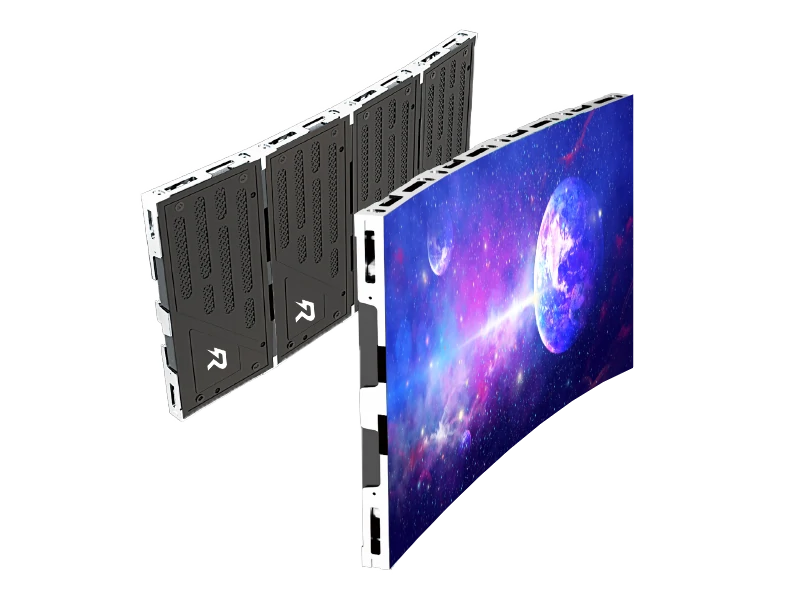
Yes. Many P2.6 cabinets support curved installations. Fixed installation cabinets typically allow 0-10 degrees of curvature per panel, enabling gentle convex or concave configurations. Rental cabinets with precision quick-lock systems often support finer adjustment increments for smoother curves. For truly custom shapes like tight-radius curves or columns, some manufacturers offer flexible LED modules or custom-curved cabinets, though this typically adds 10-20 days to production time.
P2.6 panels typically consume 150-250W per square meter on average, with peak consumption reaching 400-600W per square meter when displaying full white content at maximum brightness. For a standard 5m×3m P2.6 wall (15 m²), that's approximately 2.25-3.75 kW average and up to 6-9 kW peak. Energy-efficient models with common cathode LED technology can reduce consumption by 20-30% compared to traditional designs.
Regular maintenance includes cleaning the LED module surface every 2-3 months using a soft, dry microfiber cloth, inspecting cabinet connections and locking mechanisms quarterly, checking for dead pixels monthly and replacing affected modules promptly, verifying power supply operation and checking for unusual heat, and keeping spare modules and power supplies on hand for quick replacements. For 24/7 installations, schedule preventive maintenance during off-hours every six months.
SMD (Surface Mount Device) is the traditional LED packaging technology where individual red, green, and blue LED chips are mounted on a PCB. Most P2.6 panels on the market use SMD technology. COB (Chip on Board) directly bonds LED chips to the PCB and encapsulates them in a single package, creating a smoother surface with better protection against physical damage and improved contrast ratios. COB panels are typically 20-40% more expensive than equivalent SMD panels but offer superior durability and image quality for demanding applications like broadcast studios and control rooms.
.jpg "Which Direct View LED Video Wall Manufacturers Offer the Best Quality and Value?")